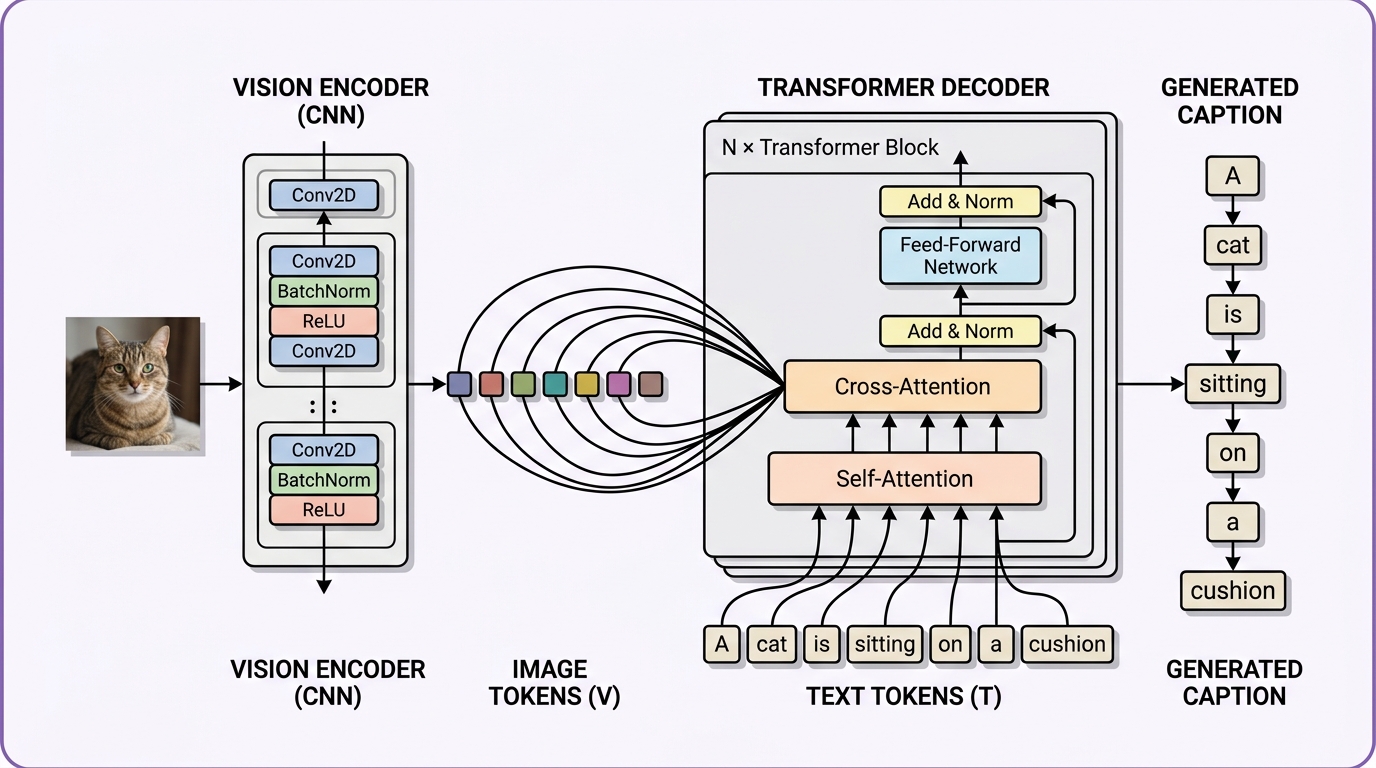
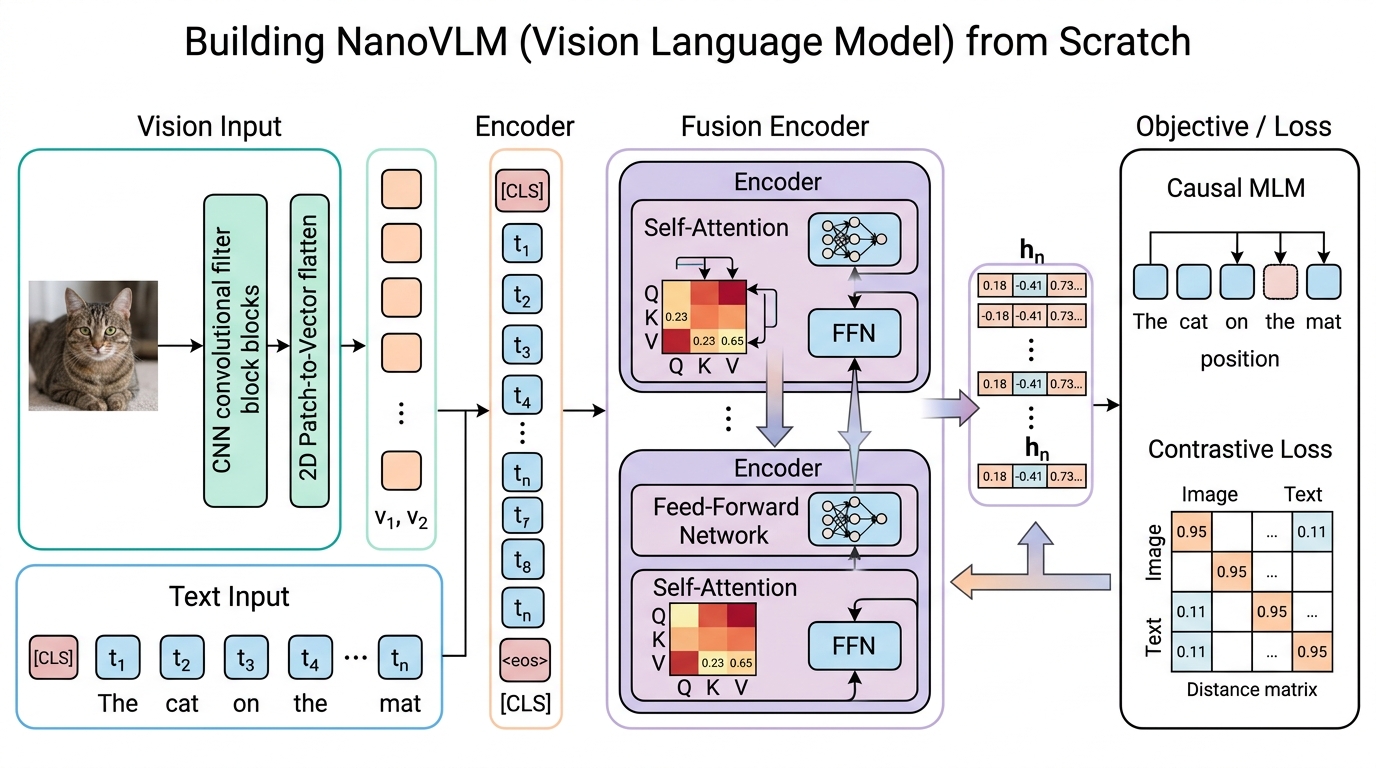
Build a NanoVLM from scratch thumbnail 1
Build a NanoVLM from scratch thumbnail 2
Build a NanoVLM from scratch

Build a NanoVLM from scratch

Gain hands-on experience building a functional Vision Language Model (VLM) from the ground up using PyTorch, interactive workshops, and expert-curated materials.

View course on Vizuara
InstructorVizuara Team
FormatLive Workshop & Self-Paced
Sessions5 Modules
AudienceMachine Learning Practitioners
Course Description

This course provides a structured pathway for developers and researchers to construct a NanoVLM. You will move beyond theory to implement a functioning model, supported by video lectures, hand-written architectural notes, and practical code files.

Participants will engage with the core components of vision-language architectures, including data handling, model construction, and training loops, culminating in a working model.

Learning Outcomes

By the end of this course, you will be able to:

Prerequisites
Course Sessions
Module
01

VLM Foundations & Overview

An introduction to the core concepts of Vision Language Models and the roadmap for building your own NanoVLM.

Review the VLM PDF booklet before attending the session.

Core Topics

  • VLM Architecture
  • Multi-modal learning basics
  • Project roadmap

Resources & Assignments

Lecture VideoVLM PDF Booklet
Module
02

Environment & Data Setup

Setting up the development environment and preparing the data pipeline for vision-language tasks.

Ensure your Colab environment is configured with the provided imports.

Core Topics

  • PyTorch setup
  • Dataset preparation
  • Image preprocessing

Hands-On Resources

ColabCode
Module
03

Model Architecture Design

Deep dive into the structural components of the NanoVLM using visual aids and architectural diagrams.

Use the Miro board to visualize the model layers.

Core Topics

  • Embedding layers
  • Model blocks
  • Architecture design

Hands-On Resources

Miro BoardHand-written notes
Module
04

Implementation & Training

Writing the training loop and implementing the model logic in code.

Focus on the training loop implementation in the provided notebook.

Core Topics

  • Training loops
  • Loss functions
  • Model optimization

Hands-On Resources

ColabCode
Module
05

Integration & Review

Finalizing the model, reviewing performance, and wrapping up the build process.

Final check of the model integration.

Core Topics

  • Model evaluation
  • Integration
  • Final project review

Resources & Assignments

ProjectAssignment
Assessments

NanoVLM Implementation

Successfully build and train a functioning NanoVLM using the provided Colab notebook.

Architecture Review

Demonstrate understanding of the model components by mapping them to the provided hand-written notes.