Foundations for ML thumbnail 1
Foundations for ML

Foundations for ML

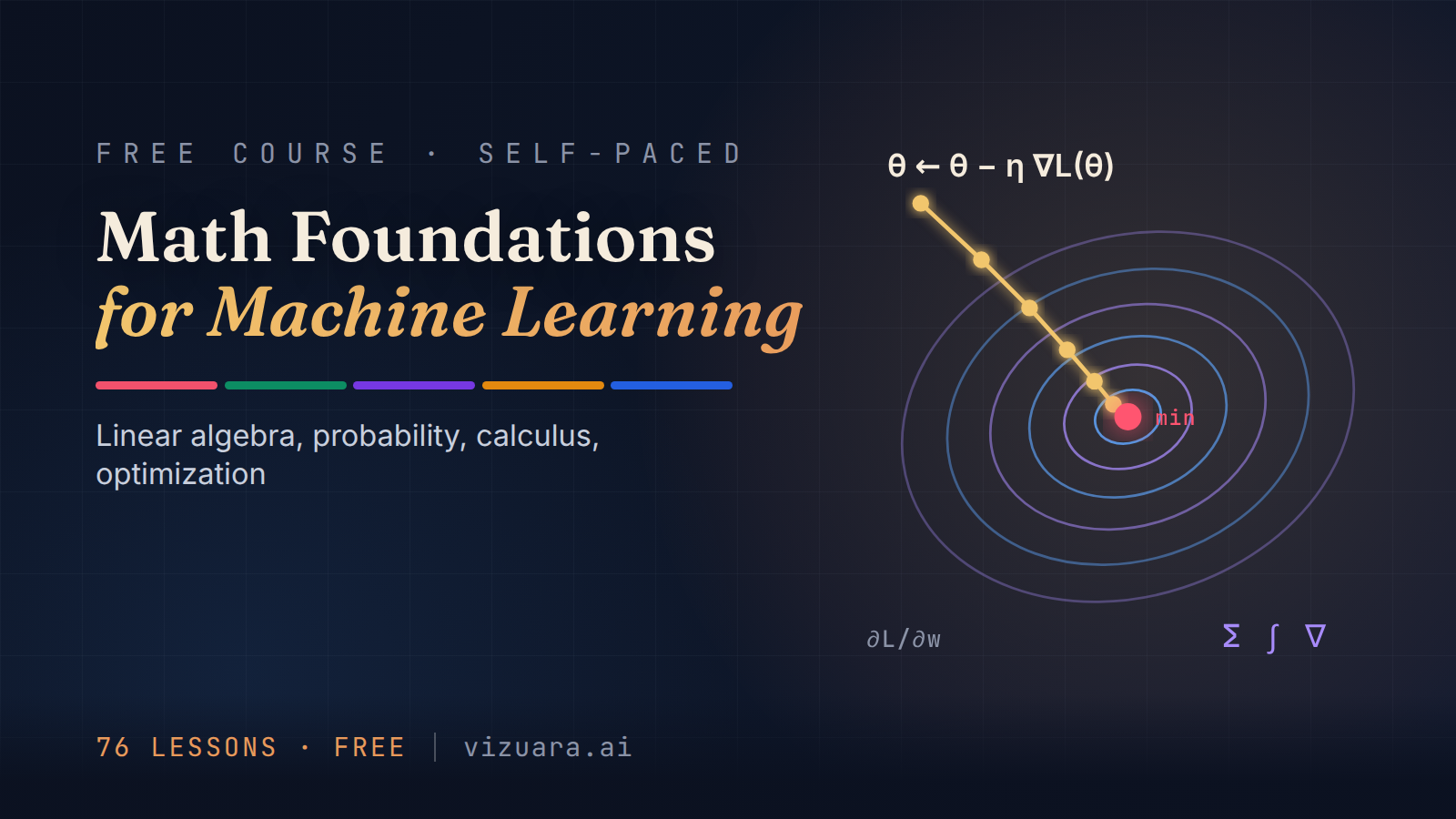
Master the essential mathematical and computational pillars required to build, train, and optimize modern machine learning models.

View course on Vizuara
InstructorVizuara Faculty
FormatSelf-paced with Video Lectures
Sessions8 Modules
AudienceAspiring ML Engineers
Course Description

This course provides a comprehensive deep dive into the mathematical foundations of machine learning, covering linear algebra, probability, and calculus.

Students will bridge the gap between theoretical concepts and practical implementation using industry-standard Python libraries like Scikit-learn.

Learning Outcomes

By the end of this course, you will be able to:

Prerequisites
Course Sessions
Module 1
01

Linear Algebra Fundamentals

Explore vectors, spans, bases, and the geometric intuition behind matrix transformations.

Focus on the relationship between matrices and 3D transformations.

Core Topics

  • Vectors
  • Span and Basis
  • 3D Transformations
  • Matrix Multiplication

Hands-On Resources

Lecture VideoHand-written Notes
Module 2
02

Advanced Matrix Operations

Deep dive into determinants, inverses, and the physical meaning of non-square matrices.

Essential for understanding dimensionality reduction.

Core Topics

  • Determinants
  • Matrix Inverses
  • Non-square Matrices
  • Eigenvalues and Eigenvectors

Hands-On Resources

Lecture VideoHand-written Notes
Module 3
03

Probability and Statistics

Build a foundation in probabilistic reasoning and statistical inference for ML.

Includes practical applications of Bayes' theorem.

Core Topics

  • Probability Distributions
  • Conditional Probability
  • Bayes Theorem
  • Hypothesis Testing

Hands-On Resources

Lecture VideoHand-written Notes
Module 4
04

Calculus for Machine Learning

Learn the calculus behind model training, specifically gradients and backpropagation.

Focus on the chain rule and its role in neural network training.

Core Topics

  • Partial Derivatives
  • Gradients
  • Chain Rule
  • Integrals for ML

Hands-On Resources

Lecture VideoHand-written Notes
Module 5
05

Optimization Algorithms

Understand how models learn through various gradient descent strategies.

Compare different optimizers used in deep learning.

Core Topics

  • Stochastic Gradient Descent
  • Momentum
  • RMSprop
  • Adam Optimizer

Hands-On Resources

Lecture VideoHand-written Notes
Module 6
06

Data Visualization

Techniques for interpreting data and model performance through visual representation.

Practical coding session for data exploration.

Core Topics

  • Visualization Principles
  • Plotting Libraries
  • Data Interpretation

Hands-On Resources

Lecture VideoCodeDataset
Module 7
07

ML Libraries in Python

Introduction to the standard ecosystem for machine learning in Python.

Focus on Scikit-learn workflows.

Core Topics

  • Scikit-learn API
  • Deep Learning Libraries
  • Model Pipelines

Hands-On Resources

Lecture VideoColab
Module 8
08

Capstone Integration

Synthesize mathematical and coding skills to solve a classification problem.

Final project application.

Core Topics

  • Naive Bayes Classification
  • Regularization
  • Model Evaluation

Hands-On Resources

ProjectAssignment
Assessments

Mathematical Problem Sets

Weekly assignments covering linear algebra and calculus derivations.

Coding Challenges

Implementation of optimization algorithms and data visualization tasks in Python.

Final Capstone Project

Building and evaluating a classification model using Scikit-learn.