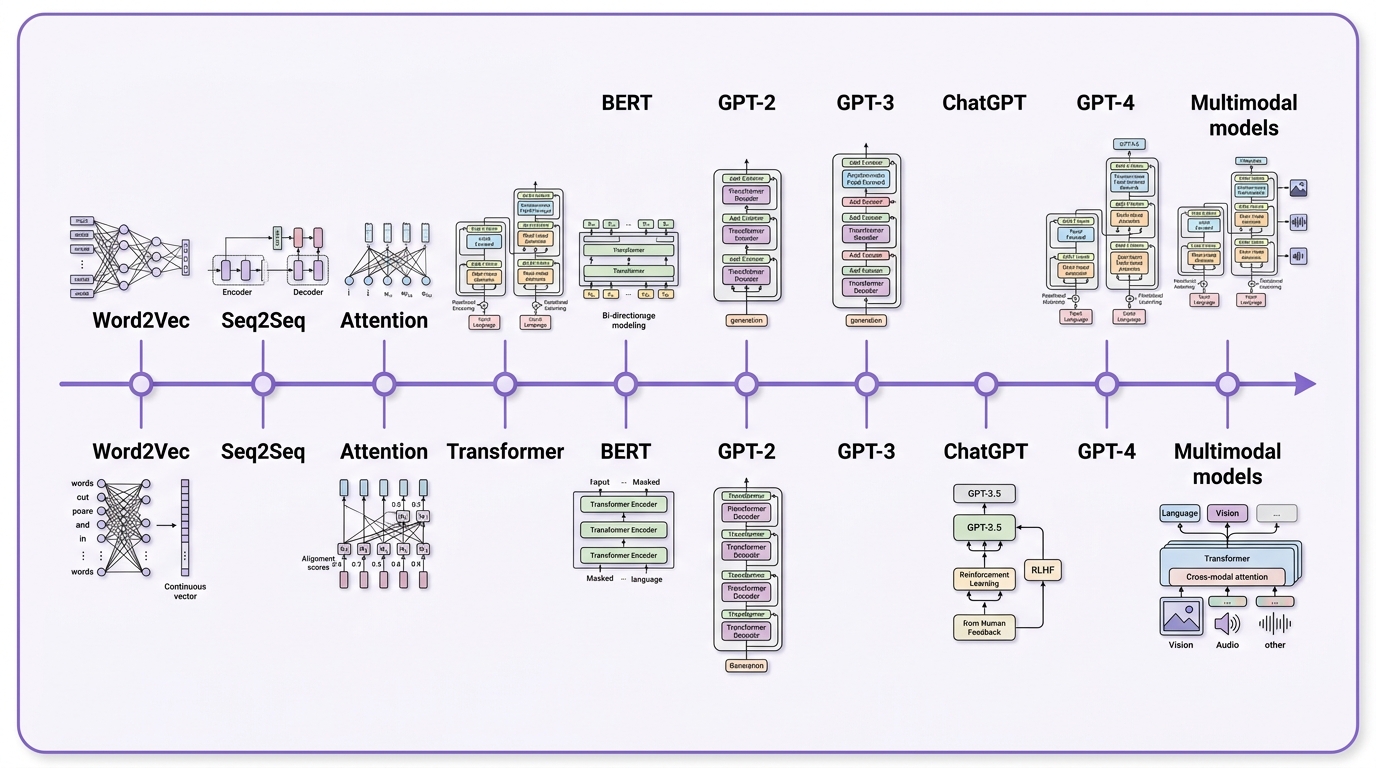
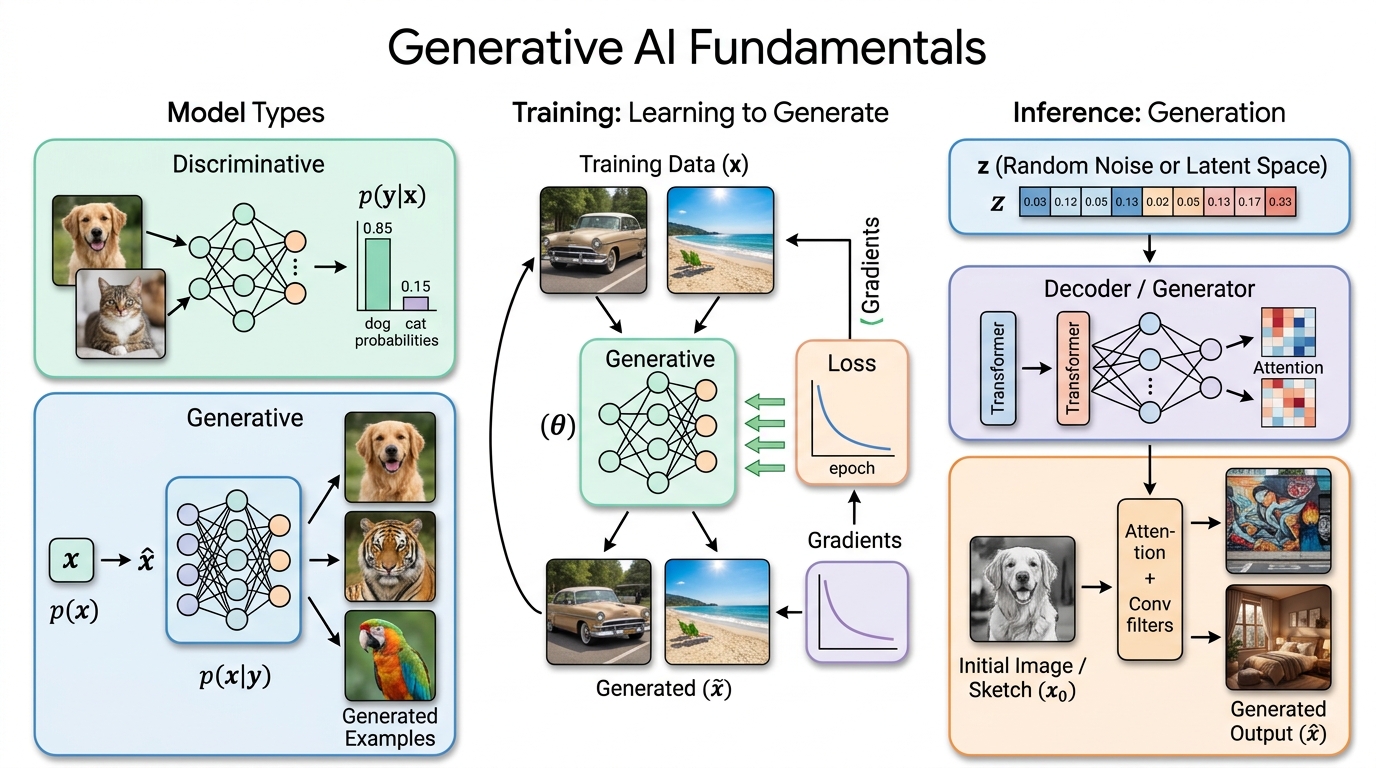
Introduction to Generative AI
An overview of the generative AI landscape and the tools shaping modern marketing and creative workflows.
Core Topics
- Generative AI overview
- AI tools for marketing
- Course roadmap
Resources & Assignments
Master the core techniques of generative AI, from foundational RNNs and LSTMs to cutting-edge Transformers, GANs, and Diffusion models through hands-on Python coding.
View course on VizuaraThis course provides an in-depth exploration of generative AI techniques. Students will progress from foundational AI tools for marketing to building sophisticated neural network architectures.
The curriculum emphasizes a hands-on approach, utilizing Python and Google Colab to implement models from scratch. You will gain practical experience in language translation, text generation, and advanced image synthesis.
Upon completion, students will be able to:
An overview of the generative AI landscape and the tools shaping modern marketing and creative workflows.
Core Topics
Resources & Assignments
Exploring the history of generative AI and the fundamental role of Recurrent Neural Networks in processing sequential data.
Core Topics
Hands-On Resources
Deep dive into the theory and implementation of RNNs, moving from mathematical foundations to functional code.
Core Topics
Hands-On Resources
Tackling the limitations of standard RNNs by implementing Long Short-Term Memory networks for complex tasks.
Core Topics
Hands-On Resources
Understanding the shift from sequential processing to attention-based models that power modern LLMs.
Core Topics
Hands-On Resources
Introduction to adversarial training for image generation, focusing on the interplay between generators and discriminators.
Core Topics
Hands-On Resources
Exploring cutting-edge diffusion models for high-fidelity image generation and complex structure synthesis.
Core Topics
Resources & Assignments
Practical application of AI tools in a simulated marketing and branding scenario.
Build and document a functional Recurrent Neural Network from scratch using Python.
Develop a GAN model to generate realistic images and demonstrate performance on the CIFAR-10 dataset.