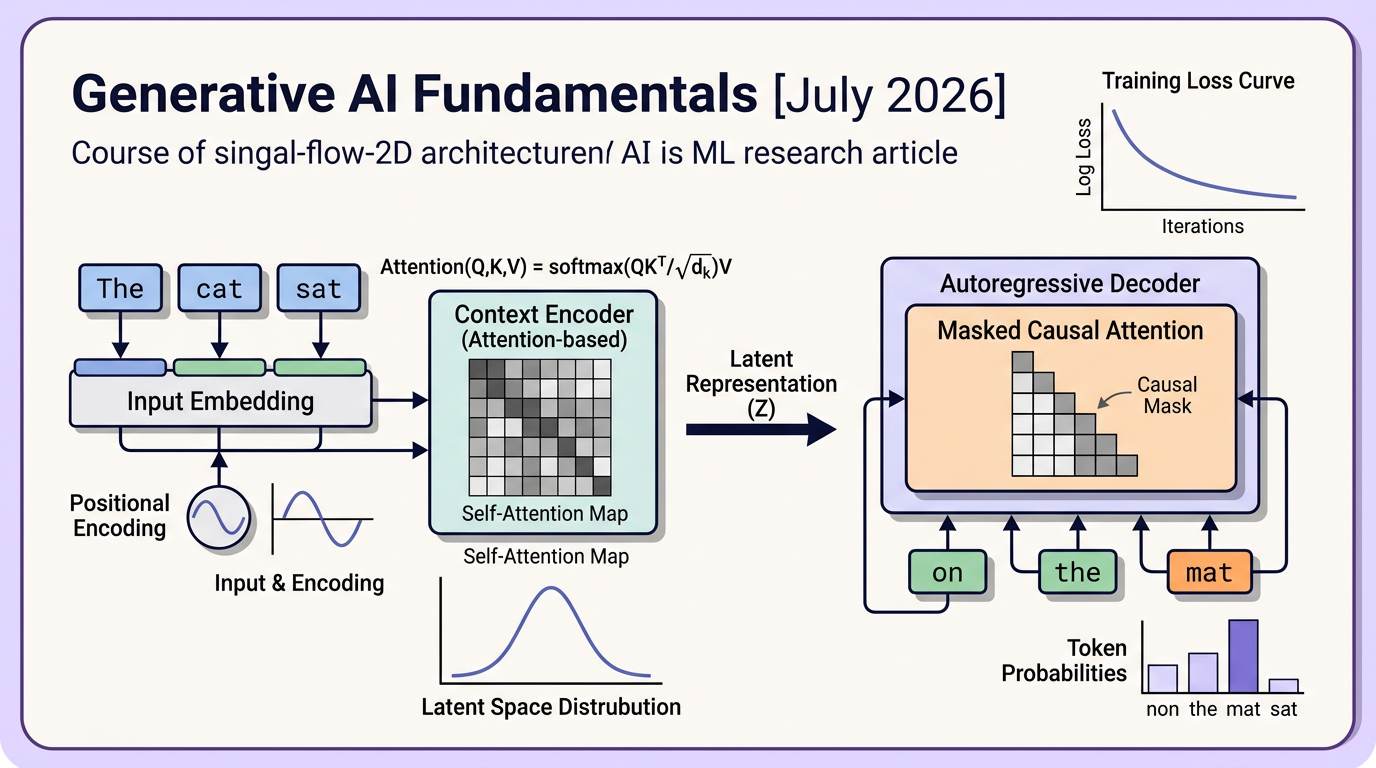
Generative AI Fundamentals [July 2026] thumbnail 1
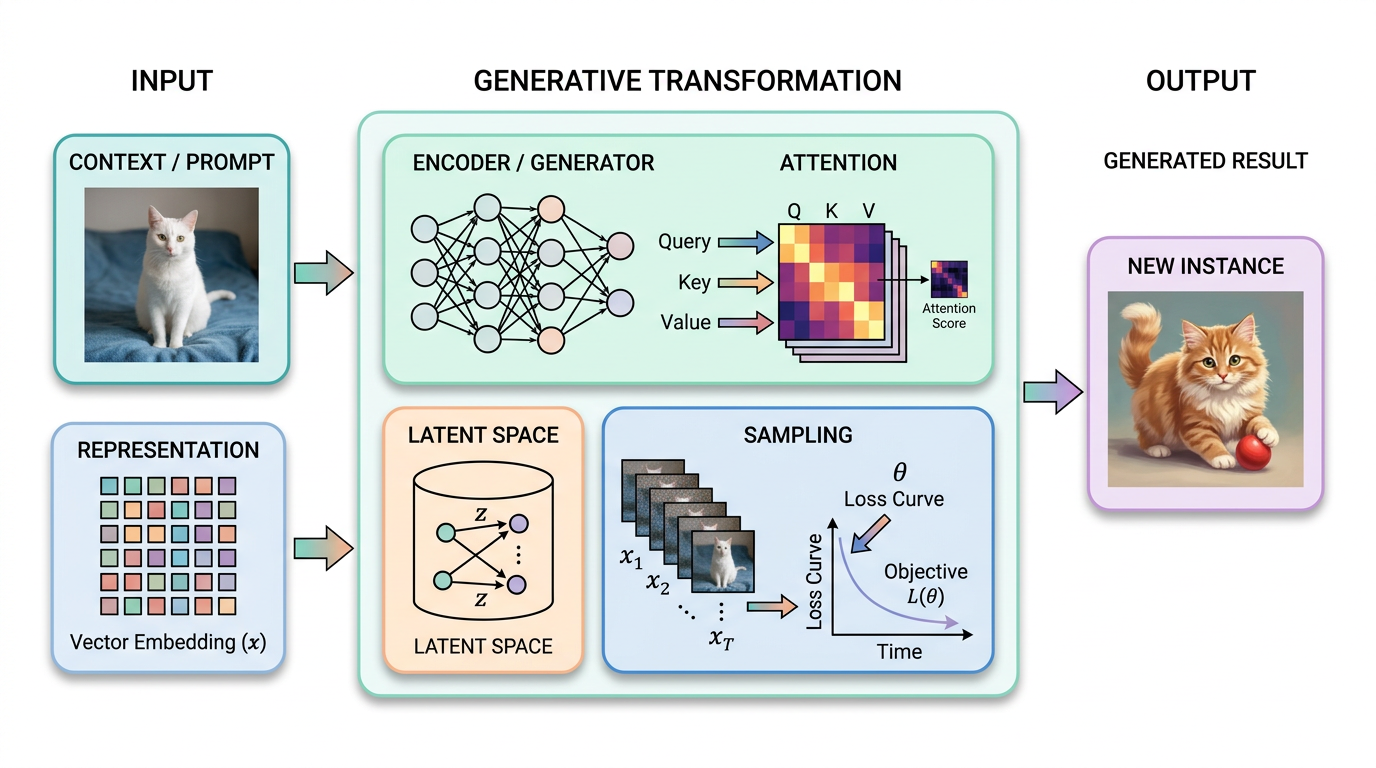
Generative AI Fundamentals [July 2026] thumbnail 2
Generative AI Fundamentals [July 2026]

Generative AI Fundamentals [July 2026]

A comprehensive journey through the evolution of Generative AI, from foundational Recurrent Neural Networks and LSTMs to modern Transformers and Diffusion Models.

View course on Vizuara
ModeSelf-Paced
Duration10 Weeks
LevelIntermediate
AudienceLearners
Course Description

This course provides a deep dive into the architecture and implementation of generative models.

Starting with the history of RNNs and LSTMs, students progress through Attention mechanisms, GANs, and state-of-the-art Diffusion models.

Learning Outcomes

By the end of this course, you will be able to:

Prerequisites
Course Sessions
Orientation
00

Course Orientation & Logistics

Essential information regarding course structure, office hours, and communication channels.

Please review all orientation materials before starting the technical modules.

Topics Covered

  • Course roadmap
  • Office hours schedule
  • Communication guidelines
  • Kick-off meeting summary

Resources

Course ReadmeOffice Hours Zoom LinkKick-off Session Recording
Module 1
01

Introduction to Generative AI & RNNs

Foundations of Generative AI and the role of memory in sequence modeling.

Focus on understanding how RNNs compress information.

Topics Covered

  • Generative AI basics
  • RNN architecture
  • Memory and context length
  • RNN limitations

Resources

Lecture 1 VideoLecture 2 VideoRNN Google Colab Notebook
Module 2
02

Building RNNs from Scratch

Translating theory into code by implementing an RNN architecture.

Hands-on coding session using Google Colab.

Topics Covered

  • Encoder-Decoder architecture
  • Hidden states and embeddings
  • Matrix operations
  • Python implementation

Resources

Lecture 3 & 4 VideosRNN Implementation Notebook
Module 3
03

Long Short-Term Memory (LSTM) Networks

Overcoming RNN limitations with gating mechanisms.

Learn to implement LSTM-based translators and text generators.

Topics Covered

  • LSTM architecture
  • Forget, input, and output gates
  • Sequence prediction
  • Text generation

Resources

LSTM Theory VideoLSTM Translator NotebookLSTM Text Generator Notebook
Module 4
04

Attention Mechanisms

Understanding how models focus on specific context to disambiguate meaning.

Crucial foundation for understanding Transformers.

Topics Covered

  • Polysemy in NLP
  • Attention layers
  • Positional embeddings
  • PyTorch implementation

Resources

Attention Theory VideoAttention PyTorch Code
Module 5
05

Generative Adversarial Networks (GANs)

Introduction to adversarial training and image generation.

Learn the competitive dynamics between generators and discriminators.

Topics Covered

  • GAN architecture
  • Discriminator training
  • Generator training
  • CIFAR-10 project

Resources

GAN Introduction VideoCIFAR-10 GAN Notebook
Module 6
06

Advanced GAN Applications

Scaling GANs for complex image generation tasks.

Focus on generating realistic human faces.

Topics Covered

  • Loss functions
  • Computational considerations
  • Face generation
  • PyTorch implementation

Resources

Fake Faces GAN VideoFake Faces GAN Notebook
Module 7
07

Transformers for Text Generation

Deep dive into tokenization and the Transformer architecture.

Explore subword tokenization and byte-pair encoding.

Topics Covered

  • Subword tokenization
  • Token embeddings
  • Transformer architecture
  • Text generation pipeline

Resources

Transformer Theory VideosTransformer Colab Notebook
Module 8
08

Introduction to Diffusion Models

Learning the iterative denoising process for image generation.

Learn to use the Hugging Face diffusers library.

Topics Covered

  • Diffusion process
  • Pixel space
  • Text guidance
  • Hugging Face integration

Resources

Diffusion Intro VideoButterfly Diffusion Notebook
Module 9
09

Fine-tuning Diffusion Models

Adapting pre-trained models to specific datasets.

Practical session on fine-tuning for custom outputs.

Topics Covered

  • Fine-tuning techniques
  • Inference schedulers
  • Logographic language generation
  • Custom datasets

Resources

Fine-tuning VideoChinese Character Generation Notebook
Module 10
10

Stable Diffusion & CLIP

Understanding text-guided image generation and modern diffusion architectures.

Final module covering advanced integration.

Topics Covered

  • Text guidance
  • CLIP integration
  • Stable Diffusion theory
  • Advanced code implementation

Resources

Stable Diffusion VideoStable Diffusion Notebook
Assessments

Mid-term Assignment

Handwritten LSTM implementation project to demonstrate understanding of sequence modeling.

Portfolio Project

Document a course-aligned implementation or analysis for review and future reference.