Mathematical Foundations for Machine Learning [July 2026] thumbnail 1
Mathematical Foundations for Machine Learning [July 2026] thumbnail 2
Mathematical Foundations for Machine Learning [July 2026]

Mathematical Foundations for Machine Learning [July 2026]

Master the essential linear algebra, calculus, and statistical concepts that power modern machine learning algorithms and data science workflows.

View course on Vizuara
Duration11 Weeks
LevelIntermediate
FormatSelf-Paced
AudienceLearners
Course Description

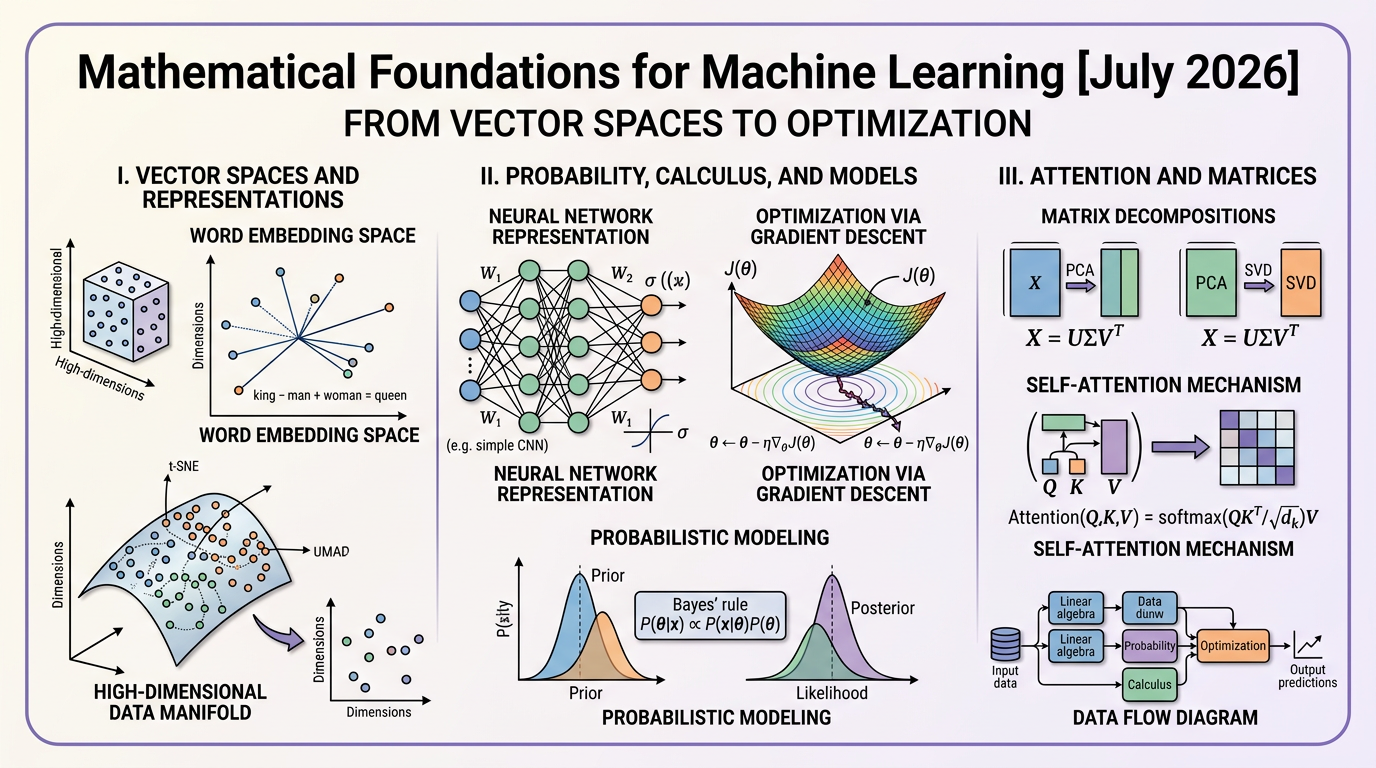
This course provides a comprehensive deep dive into the mathematical pillars of machine learning. You will progress from fundamental linear algebra and vector spaces to advanced optimization algorithms and deep learning library implementations.

Through a blend of theoretical lectures, geometric visualizations, and hands-on Python coding sessions, you will gain the intuition required to understand how models learn and how to implement them from scratch.

Learning Outcomes

By the end of this course, you will be able to:

Prerequisites
Course Sessions
Orientation
00

Course Logistics & Kick-off

Essential orientation, office hour schedules, and course expectations.

Review all materials before starting Week 1.

Topics

  • Course Roadmap
  • Office Hours Schedule
  • Communication Channels
  • Kick-off Session Recap

Materials

Course ReadmeZoom Meeting LinksMiro Notes
Week 1
01

Linear Algebra Foundations

Introduction to vector spaces, linear transformations, span, and basis vectors.

Focus on the geometric intuition behind vector operations.

Key Concepts

  • Vector Spaces
  • Span and Basis
  • Linear Dependence/Independence

Resources

Video LecturesInteractive NotesOffice Hours Recording
Week 2
02

Matrix Transformations

Exploring matrix multiplication as rotations, scaling, and shear transformations.

Crucial for understanding how neural networks manipulate data.

Key Concepts

  • Matrix Multiplication
  • Linear vs Nonlinear Transformations
  • Geometric Interpretation

Resources

Video LecturesInteractive Project Notes
Week 3
03

3D Transformations & Determinants

Extending linear algebra to 3D space and understanding the geometric role of determinants.

Focus on dimensionality reduction concepts.

Key Concepts

  • 3D Transformations
  • Dimensionality Reduction
  • Determinants as Scaling Factors

Resources

Video LecturesInteractive Notes
Week 4
04

Determinants, Inverses & Probability

Advanced linear algebra and the introduction to probability and statistics.

Bridge the gap between linear algebra and probabilistic modeling.

Key Concepts

  • Matrix Inverses
  • Systems of Equations
  • Bayes' Theorem
  • Statistical Measures

Resources

Video LecturesInteractive Notes
Week 5
05

Naive Bayes & Distributions

Applying probability to classification tasks and understanding data distributions.

Practical application in spam detection.

Key Concepts

  • Naive Bayes Classifier
  • Feature Independence
  • Probability Distributions

Resources

Video LecturesInteractive Notes
Week 6-7
06

Python for Machine Learning

Introduction to Python programming, OOP, and building neural networks from scratch.

Transition from theory to implementation.

Key Concepts

  • Python Syntax
  • OOP in ML
  • Linear Regression
  • Gradient Descent

Resources

Video LecturesCode WalkthroughsInteractive Projects
Week 8-9
07

Data Science Libraries

Mastering NumPy for computation and Pandas/Visualization libraries for EDA.

Essential tools for data manipulation.

Key Concepts

  • NumPy Arrays
  • Pandas Dataframes
  • Matplotlib/Seaborn/Plotly

Resources

Video LecturesCode FilesDebugging Practice
Week 10-11
08

Deep Learning & Optimization

Deep learning library usage and advanced optimization algorithms.

Final module covering model training mechanics.

Key Concepts

  • Deep Learning Frameworks
  • Optimization Algorithms
  • RMSProp & Adam

Resources

Video LecturesCode FilesOptimization Notes
Assessments

Weekly Office Hour Queries

Active participation in submitting conceptual and technical queries for live discussion.

Coding Challenges

Hands-on implementation of matrix operations, regression models, and data visualization tasks.