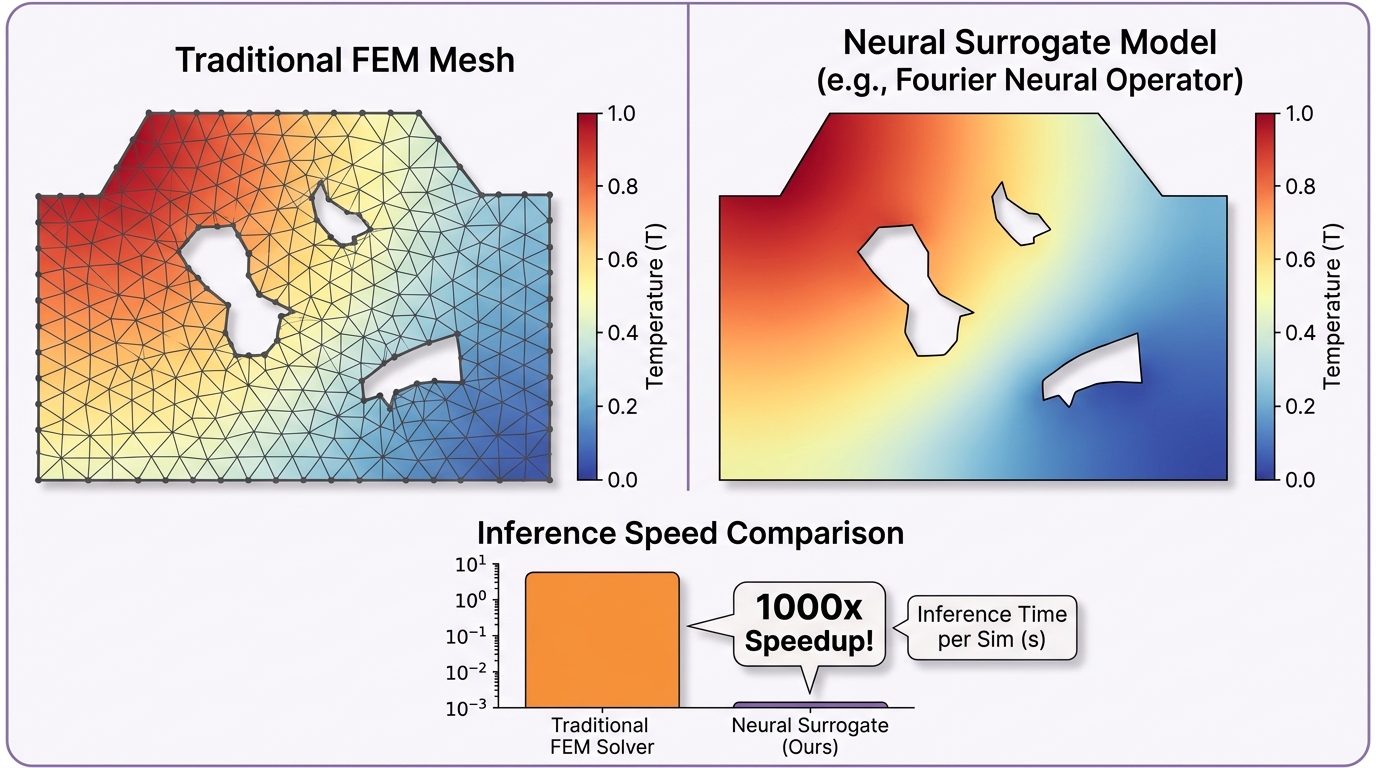
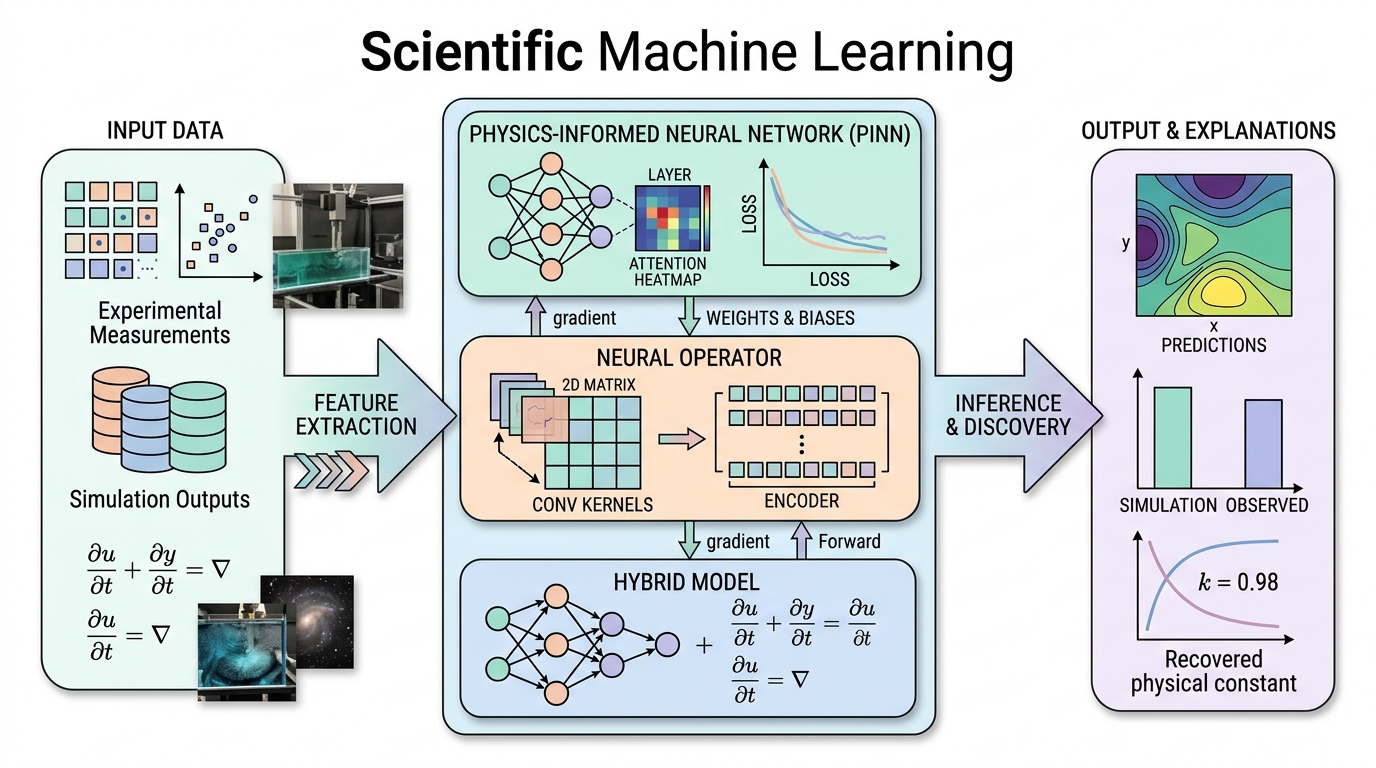
Scientific Machine Learning [July 2025 Cohort] thumbnail 1
Scientific Machine Learning [July 2025 Cohort] thumbnail 2
Scientific Machine Learning [July 2025 Cohort]

Scientific Machine Learning [July 2025 Cohort]

Master the integration of machine learning with scientific inquiry, focusing on Universal Differential Equations and predictive modeling for complex systems.

View course on Vizuara
InstructorDr. Sreedath Panat
FormatLive Zoom Lectures
Sessions12 Modules
AudienceResearchers & Data Scientists
Course Description

This course provides a rigorous path for students to bridge the gap between traditional scientific modeling and modern machine learning.

Participants will utilize the Julia programming language within Jupyter Notebooks to build and deploy models, including Physics-Informed Neural Networks (PINNs) and Universal Differential Equations (UDEs).

Learning Outcomes

By the end of this course, students will be able to:

Prerequisites
Course Sessions
Module
01

Introduction to SciML

Course orientation, agenda setting, and an overview of the scientific machine learning landscape.

Ensure your Julia environment is configured in Jupyter.

Core Topics

  • Course roadmap
  • Julia for SciML
  • Scientific inquiry vs. ML

Resources & Assignments

Lecture VideoSlides
Module
02

Differential Equations & Loss Functions

Deep dive into the mathematical foundations of differential equations and the role of cross-entropy loss in scientific models.

Focus on the transition from traditional solvers to ML-integrated solvers.

Core Topics

  • Differential equation solvers
  • Cross entropy loss
  • Optimization basics

Resources & Assignments

Lecture VideoColabAssignment
Module
03

Neural Networks & PINNs

Exploring the architecture of Physics-Informed Neural Networks and their application to scientific constraints.

Hands-on implementation of PINNs in Julia.

Core Topics

  • Neural network architectures
  • Physics-Informed constraints
  • Training stability

Resources & Assignments

Lecture VideoCodeAssignment
Module
04

Complexity, Accuracy, and Noise

Analyzing the trade-offs between computational complexity and model accuracy, and handling noise in forecasting.

Critical analysis of model performance metrics.

Core Topics

  • Computational complexity
  • Accuracy metrics
  • Noise variation
  • Forecasting

Resources & Assignments

Lecture VideoDataset
Module
05

Universal Differential Equations (UDEs)

Advanced application of UDEs to real-world scientific problems including SIR models and tumor growth.

Project-based application of UDEs.

Core Topics

  • SIR model integration
  • Cancer tumor modeling
  • UDE implementation

Resources & Assignments

Lecture VideoProjectColab
Module
06

Equation Discovery & Research Writing

Techniques for automated equation discovery and the process of drafting scientific research papers in the field.

Final project preparation.

Core Topics

  • Automated equation discovery
  • Scientific paper drafting
  • Peer review process

Resources & Assignments

Lecture VideoAssignment
Assessments

In-Lecture Assignments

Collaborative problem-solving tasks conducted during live Zoom sessions.

Take-Home Assignments

Implementation tasks focused on coding models in Julia and analyzing results.

Research Paper Draft

A final project requiring students to apply SciML techniques to a scientific problem and document the findings.