Vision-Language-Action for Autonomous Driving thumbnail 1
Vision-Language-Action for Autonomous Driving thumbnail 2
Vision-Language-Action for Autonomous Driving

Vision-Language-Action for Autonomous Driving

A live bootcamp building a complete VLA system — from raw visual input to language-guided reasoning to physical robot control.

View course on Vizuara
InstructorSreedath Panat
FormatLive Bootcamp
Sessions7 + Orientation
AudienceUndergrad · Grad · Industry
Course Description

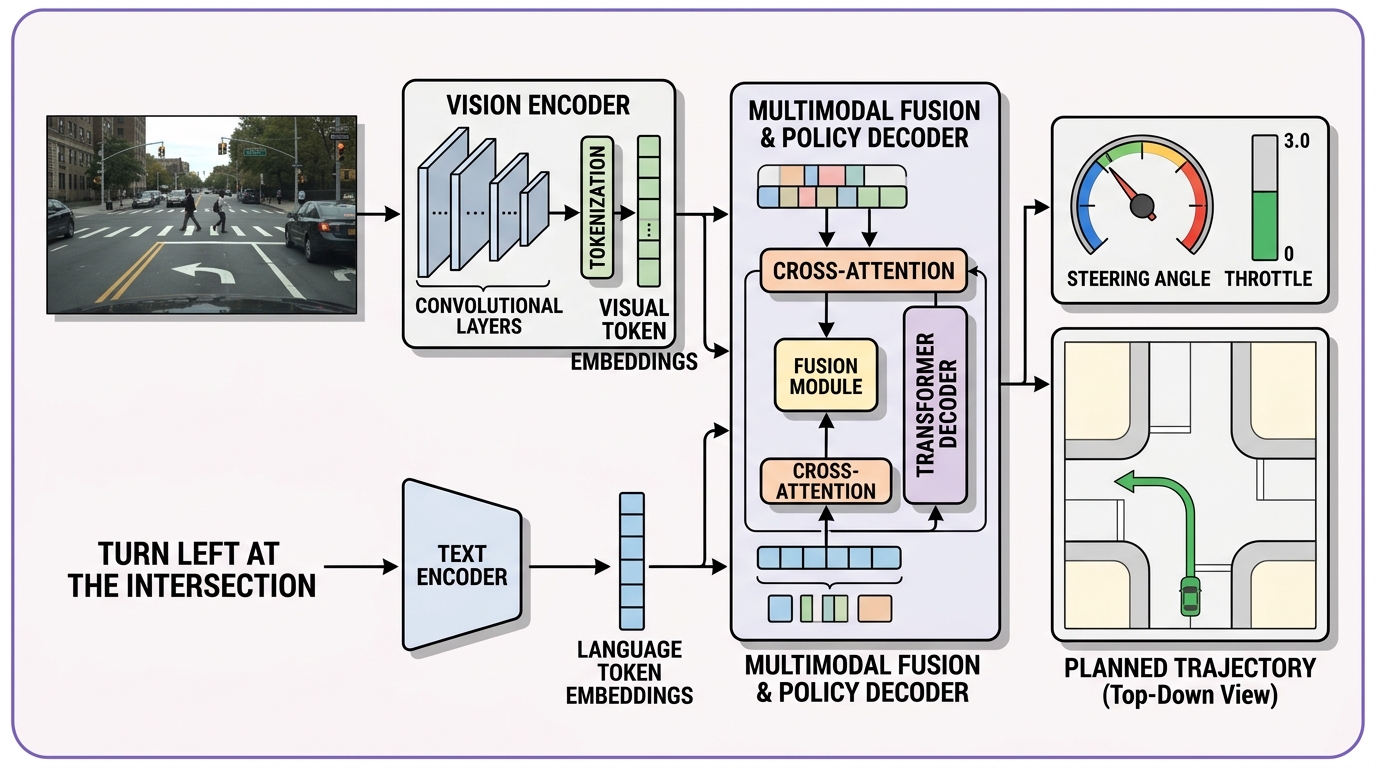
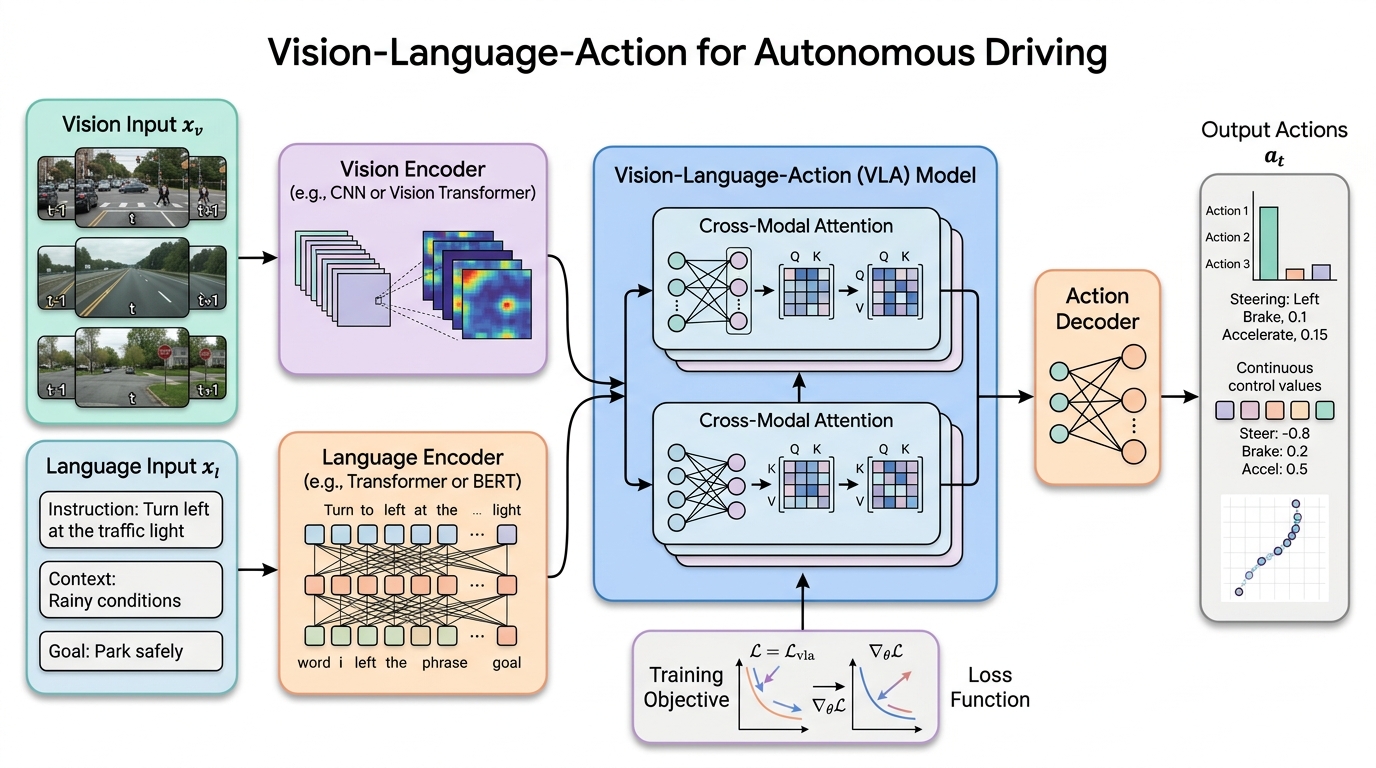
This bootcamp teaches you how to build a complete Vision-Language-Action system for autonomous driving — moving from visual perception through language-guided reasoning to physical action and control. The focus is not only on models but on real system behavior: hardware constraints, latency, noisy sensing, imperfect control, deployment issues, and why end-to-end autonomy systems fail in practice.

Learning Outcomes

By the end of this course, you will be able to:

Prerequisites
Course Sessions
Orientation
00

Setup & Access

Logistics, communication channels, prerequisites, and PRO plan details before technical content begins.

Covered

  • Helpful background for the bootcamp
  • Timings and Zoom link
  • Discord community link
  • PRO plan details and upgrade options

Resources

ScheduleDiscordZoom
Session 1
01

Introduction to VLA

Establish the conceptual foundation — why vision alone isn't enough, and how VLA systems are structured versus simpler architectures.

Core Topics

  • What a Vision-Language-Action system is
  • Why vision alone is not enough
  • VLA vs VLM vs vision-only models
  • Introduction to simulator-based learning

Resources & Assignments

SlidesLecture VideoRT-2 PaperACT PaperVLA Simulator
Session 2
02

Action Chunking Transformer in Simulation

Deep-dive on ACT architecture and imitation learning, then use it to predict actions inside a simulation environment.

Core Topics

  • Action Chunking Transformer
  • Imitation learning for control
  • Action prediction in simulated environments
  • Evaluating trained models in simulation

Hands-On Resources

9 ExperimentsCheckpointsSimulatorCode
Session 3A
03A

Hardware & Control Foundations

Prepare for hardware-based experiments — physical robot setup, local environment configuration, and data collection pipeline basics.

Core Topics

  • Preparing for hardware-based VLA experiments
  • Understanding the physical robot setup
  • Local environment setup
  • Data collection and control pipeline basics

Resources

Lecture VideoSlidesPDF NotesGitHub Repo
Session 3B
03B

Connecting with TurboPi

Connect and command a physical TurboPi robot car — bridging the gap between simulation and real deployment.

Core Topics

  • Connecting a physical TurboPi robot
  • Running control commands
  • Bridging simulation and physical deployment
  • Debugging connection and control issues

Resources

Command ReferenceSim LinksSlidesLecture Video
Session 4
04

Introduction to World Models

Move beyond reactive control — how world models let agents predict, plan, and reason about future environment states.

Core Topics

  • What world models are
  • Predictive modeling of environment dynamics
  • Planning through learned representations
  • Connecting perception, prediction, and action

Resources

Experiment CodeDiscussionSlidesRecording
Session 5
05

Introduction to Isaac Lab

Graduate to NVIDIA's Isaac Lab — a production-grade simulation environment for robotics and autonomous control.

Core Topics

  • Isaac Lab overview and capabilities
  • Simulation for robotics and autonomous control
  • TurboPi workflows inside Isaac Lab
  • Transitioning to richer robotics environments

Resources

GitHub RepoTurboPi IntegrationSlidesLecture Video
Session 6
06

ACT Implementation in Isaac Lab

Implement the ACT policy inside Isaac Lab — train, evaluate, and connect outputs to simulated robot behavior.

Core Topics

  • Implementing ACT in Isaac Lab
  • Policy learning for robotic control
  • Training and evaluation pipeline
  • Connecting ACT outputs to robot behavior

Resources

Implementation RepoSlidesLecture Video
Session 7
07

Reinforcement Learning in Self-Driving

Explore RL as an alternative and complement to imitation learning — reward design, policy learning, and safety constraints.

Session resources are being prepared — materials will be posted before the live class.

Core Topics

  • Reinforcement learning for autonomous driving
  • Reward design and shaping
  • Policy learning and exploration
  • Simulation-based RL training
  • Exploration and safety constraints
  • Comparison with imitation learning and ACT
Assessments

Session Assignments

RT-2 paper reading, ACT paper reading, and VLA simulator training tasks across early sessions.

Course End Test

Conceptual and practical questions across VLA, ACT, world models, Isaac Lab, and deployment constraints.

Final Project

Build and document a VLA pipeline that converts visual input into executable control actions.